
#WTH United Nations impunity
For murderers, terrorists, rapists. Really.

Let’s assume most of this article’s readers think the Hamas attack of October 7, 2023 was a bad thing. Perhaps you don’t like Israel’s response. Perhaps you wish Israel had gone further. But generally speaking, you frown on wanton murder, rape, kidnapping, and terrorism.
Let’s also assume that as a taxpayer — and most of us are — you frown on subsidizing the aforementioned murder, rape, kidnapping, and terrorism.
Let’s round out this litany of virtues and note that you probably like the idea of justice being served to those who engage in murder, rape, kidnapping, and terrorism. Maybe you’re the kind of person who applauds Israel hunting down every single Hamas terrorist involved with October 7, and killing them. (I am.) But at the very least, you think that those accused of such crimes should face a jury of their peers, a judge, or some legal equivalent.
Guess who disagrees? Antonio Guterres, Secretary General of the United Nations. Guess who helps pay Mr. Guterres’ $420,000 per annum salary? If you guessed the United States taxpayer pays the biggest chunk, you’d be right.
But let’s begin at the beginning, with less click-baity lures. Israel provided significant information to the United Nations indicating that employees of the United Nations Relief Works Agency, a UN aid agency that works solely for Palestinian “refugees,” were commanders and members of Hamas who participated in October 7.
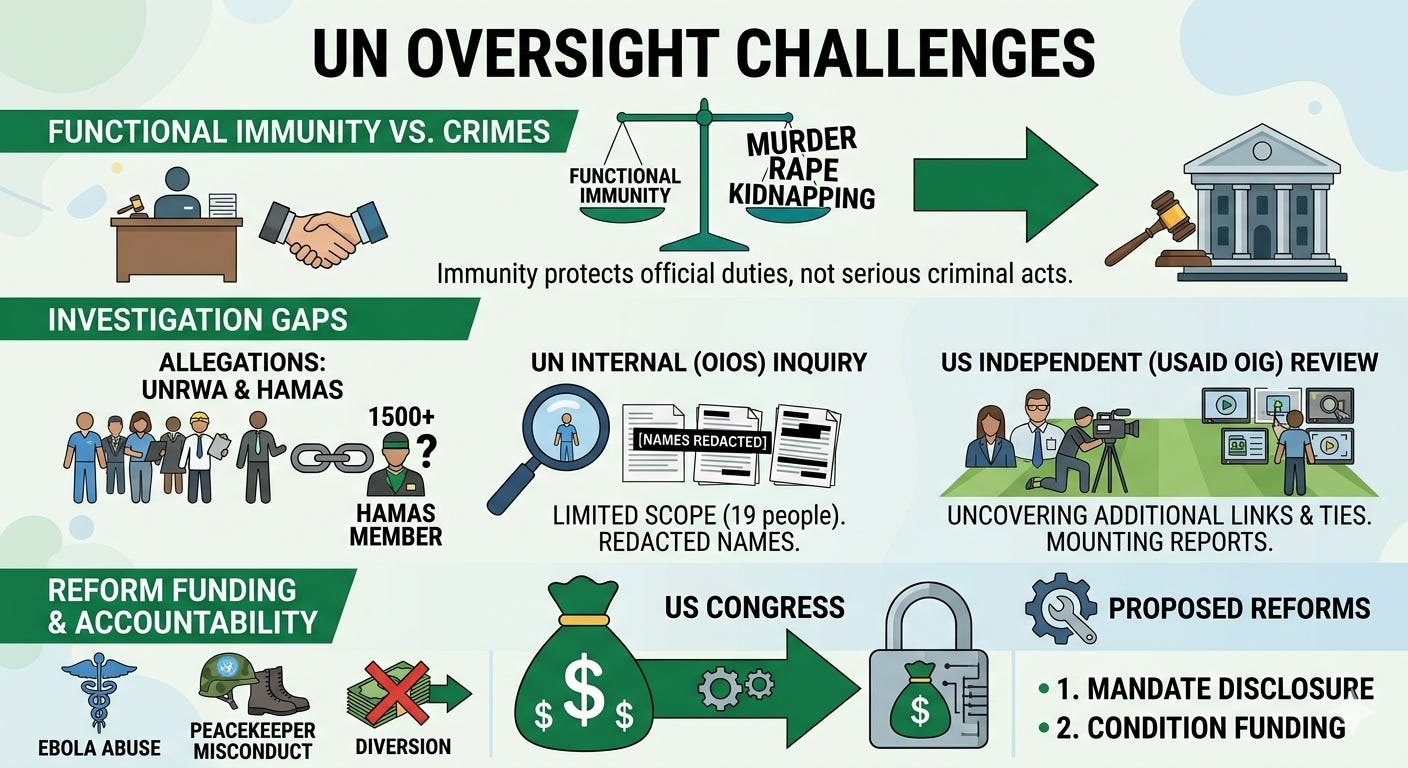
After substantial resistance, the UN’s Office of Internal Oversight Services (OIOS, the UN’s own internal inspector general) opened an investigation, ultimately targeting 19 individuals who worked for UNRWA. Nine (or perhaps 11, more on this later) were dismissed; two were dead; one was a case of mistaken identity; and the remainder were deemed kosher due to lack of evidence.
Here’s what Brett Schaefer and I wrote on the topic of UNRWA complicity in a recent Dispatch article 🎁:
The remit of the Palestinian-focused United Nations Relief and Works Agency (UNRWA) includes assistance, basic education, healthcare, and social services, but its collaboration with Hamas has long been well known. Hamas stored weapons in UNRWA schools and hospitals and located its tunnels and headquarters below them for protection, and has done so with ease given the overlap between UNRWA officials and senior Hamas militants. More recently, however, documentary evidence shows extensive Hamas infiltration and manipulation beyond UNRWA to include other international humanitarian organizations and non-governmental organizations.
Notwithstanding pressure from the United States, it was clear from the outset that OIOS wasn’t into the mission to investigate UNRWA. Better still, OIOS investigated only direct participants in October 7. Other UNRWA employees who are card carrying Hamas members, replete with military rank etc, were ignored.
Why aren’t we sure how many UNRWA employees were fired? Because OIOS, notwithstanding having agreed to share the results with the US, refused to share an unredacted version of their investigation. All the names have been blacked out. But the UN’s own desultory investigation was enough for the International Court of Justice, which claimed that Israel has not “proven” UNRWA complicity in October 7, and therefore must allow the group access to Gaza.
It’s all something of a farce.
Luckily, an office that is unfamiliar to most is on the job. The U.S. Agency for International Development — USAID, abolished under Trump and subsumed into the State Department — has its own IG that has its own independent authority and can’t be abolished. It now works within State and is investigating UNRWA’s role in October 7. Marc and I hosted USAID OIG acting Associate Deputy Inspector General Adam Kaplan on the pod to go through chapter and verse.
USAID OIG is not only scrubbing all of the available video and documentation to investigate UNRWA complicity, it’s investigating whether UNWRA officials were simultaneously working for Hamas. So far, reports suggest there are more than1500 UNRWA employees who are also card carrying Hamas members.
Listen to the whole pod for all of the sordid details.
Now let’s take all of this UN indifference one step further. Certain members of the United Nations staff enjoy privileges and immunities under a treaty with the United States. Others, however, should enjoy only what is called “functional immunity.” In essence, full P&I means if Guterres chooses to murder his wife and his undersecretaries general, he has immunity from prosecution. Others, however, only enjoy immunity for their work; so if someone in the United States wants to sue UNRWA teachers for teaching antisemitism, they can’t, because teaching (antisemitism is just the bonus education) is indeed part of UNRWA’s remit.
However, UNRWA’s remit says nothing about murder, rape, terrorism, or kidnapping. So, presumably, those UNRWA employees doing the murdering, raping, terrorizing, and kidnapping weren’t actually acting as UNRWA employees. And thus, arguing they have full immunity is a stretch. Nonetheless, that is what the Biden administration argued when suit was brought by American October 7 victims and their families. Trump’s Justice Department reversed that claim, only to see the judge in the case, Judge Analisa Torres (Obama appointee), assert UNRWA has full immunity.
Congress is now working overtime — no, really — to ensure that no more money goes to the United Nations absent a commitment to full disclosure of any and all information requested by the USG. And Congress is mooting legislation requiring all signed agreements on disclosure prior to disbursement of grants to the UN.
One final note: Some are uninterested in the crime and punishment of UNRWA. But the United Nation’s argument for impunity extends to charges of rape and abuse against World Health ORganization officials in ebola response; human trafficking, rape, and abandonment by peacekeepers; embezzlement; and more. In some of these cases, officials have been fired or forced out. But the United Nations and development organizations are free to hire them notwithstanding. Because the UN is one big get out of jail free card. And we’re paying for it.
TRANSCRIPT
Q: So, is it true that employees of UNWRA were members of Hamas and were participating in the October 7th attacks? Give us the details. What do we know, and what has the UN done or not done about it?
AK: It’s a great question. USAID Office of Inspector-General and just a little housekeeping here. I speak personally and my views do not necessarily represent the views of USAID IG, but happy to talk about this important issue. UNWRA, we got involved in mid to late 2024, and while UNRWA was not funded by USAID, it was funded by the Department of State. The reason that the USAID Inspector-General, which is a statutorily independent law enforcement agency distinct from USAID and we continue to be in existence, we appreciate the support of Congress in ensuring that this work that we’ll talk about today can continue.
With UNRWA in mid-2024, our fear is based on what we have seen in past humanitarian responses where the same individuals who had committed misconduct with either fraud, corruption, sexual exploitation and abuse in the case of WHO doctors during the initial Ebola response in the DRC, that they would recirculate. So, they may be punished by whatever UN agency they worked for and committed the misconduct if discovered. But then they would jump around and you’d start to see them at World Food Program. You start to see at UNICEF and jump one to the next to the next to the next or into the NGO sector.
And I use these as organizations hypothetically, but you could see them next to Save the Children or Mercy Corps or IRC. So, when we saw the reports on UNRWA, again, not funded by USAID, but their very real fear was that these same terrorists would jump from UNRWA to organizations that USAID could conceivably fund in the Gaza response. So, we initiated an independent investigation. First, we went up to New York. We asked the UN OIOS, their investigative body for a copy of their report. They gave us a highly redacted version where the subject’s names were redacted, which was totally useless for us. So, we opened up our own independent investigation where through various sources-
Q: So, we are funding a quarter roughly of the UN’s budget and they wouldn’t give us the names of the people involved in our inspector-general office in charge of investigating this?
AK: That is correct. They also wouldn’t share it with the US Mission to the United Nations. They would not release the names of individuals that they had found and it was a convoluted legal description that may have potentially possibly conceivably participated in the October 7th terrorist attacks. So, we got nothing from that other than a bunch of redactions of names. Again, useless to us, which is why we opened up our own matter and through our own sources, methods, channels, independent means, we have thus far referred 21 individuals that were either affiliated that we, the USAIG deems were affiliated with the October 7th terrorist attacks, including the murder of Americans and Israelis and/or Hamas members.
And that investigation is expanding, this was the first 21, the suspension debarment officer blacklisted the first, for the first time ever, blacklisted a UN official Hafez Mousa Almusa, who was a UNRWA school principal who also commanded the East Jabalia Battalion on October 7th.
Q: Reports from Capitol Hill claim that up to 1,500 members of UNRWA, are also members of Hamas. Is that what you have found?
AK: Yeah. Well, let me put it this way. I will not contradict that congressional source on that. I will also say this, back to the OIOS investigation, what they only looked at was potential UNRWA affiliated staff’s involvement in the October 7th terrorist attacks. The scope of the investigation was narrow in that they did not look at Hamas membership within ... If you’re a dual hat, you’re a Hamas military member and/or you’re a UNRWA staff. They limited their investigation, the UN investigative body, which reports to the secretary-general, limited to October 7th participation. Our investigation does not needlessly narrow the scope.
If you’re a member of Hamas and you work for a US funded aid organization, and what I said before to Marc, that you could jump around to one, to the next, to the next, next. No US taxpayer should be funding the salary of a Hamas member whose moonlighting is an aid worker. And remember on their resume, it may be a great resume. They may be a food distributor, there may be a logistician, they may be a principal and educator, have a great resume. They probably won’t put on the top of it that they’re a Hamas card carrying Hamas member of the East Jabalia Battalion on that resume. So, our investigation goes far beyond what the UN looked into and only in their case found nine out of 19 and 10 out of 19 participate in October 7th terrorist attacks. We believe it’s many more than that, but our broader investigation to Dany’s question, it is more expansive, it looks at Hamas ties.
Q: According to the United Nations, Hamas is not a terrorist organization, right? So, card-carrying membership in Hamas for the United Nations is not job-disqualifying, is it?
AK: I will give you an example. I remember being in Jerusalem in January 2025, USAID IG investigators, we held a fraud awareness forum for UN agencies and NGOs that were receiving over $1 billion of aid for the Gaza response. We had previously identified that USAID did not vet UN staff performing US government funded awards. The UN was exempted from going through USAID’s partner vetting process that NGOs and contractors had to go through. So, we asked the question to the UN agencies. We said, “Well, if the US government is reliant on you all to do your own vetting and screening for terrorist ties, describe it a little bit.”
And if an applicant for a position had in his Zoom background, a big Hamas flag that said, “Long live October 7th,” would that preclude that individual from being hired? A couple said, “Yes, this would be a problem with the neutrality.” One agency said, “No, that would flat out not preclude us from hiring that individual to work for us on an aid project because Hamas is not a UN designated terrorist organization.
Q: Why not?
AK: They would say that it’s up to the member states to go through the UN Security Council to put Hamas on the sanctions list, which we know the challenges in doing so. But the fact remains that because Hamas is not on the UN sanctions list, therefore a UN agency could reasonably make a decision to bring that person on board despite a Hamas affiliation. They’ll tell you they won’t do that, but we know it’s happening.
Q: Congress requires vetting to take place, and yet vetting isn’t taking place. So, how is Congress writing checks when that legal requirement is not satisfied?
AK: I think Congress can tighten further and include language about international organizations. So, there’s certain vetting legislation that was taken on by USAID, which I’d say was more expensive than what State Department had that required NGOs and it was partner vetting is only in seven specific locations. So, if you’re out of those seven, then there’s no vetting at all. If you’re within the seven, which would include Gaza and the West Bank, Syria, Afghanistan, Lebanon, et cetera, you would only get this, have to vet if you’re an NGO, you’re Save the Children, you’re key personnel, so, you’re C-suite people.
If you’re a contractor, your general counsel to see if they’re affiliated with a terrorist group. If you’re the UN, nobody, nobody has to get vetted. If you’re a UN staffer, you do not have to go through the US mandated screening processes. I think you will see legislation very soon. Folks on the Hill have identified this gap that the USAID IG has presented in its reports. We just did one specifically to the West Bank in Gaza flagging the high risk that is presented by a lack of vetting of UN personnel. And I imagine there will be a response to that.
Q: How much US taxpayer money has, in various ways, gone to Hamas?
AK: It’s a great question, I’ve seen several statistics on it. What I’ll tell you, there’s a lot of reliance and especially places like Gaza where no US diplomats can get to on a routine basis, if at all. Same applies for Eastern Ukraine and other what we call non-permissive environments. I’d say the flaw in relying, the challenge is relying on implementers. So, eight organizations included in the UN to self-report instances of diversion to Hamas and other terrorist organizations. I saw a piece last year in Reuters where it was some non-OIG officials were saying, “Well, Hamas, there’s never been any reports of Hamas interference of aid diversion in Gaza.”
And we said, “Hang on a second. If you’re only relying on a sanitized report from an aid organization, which maybe for good reason out of fear, out of security reasons, don’t want to identify that the guys with guns who commandeered the convoy were Hamas, they didn’t wear an H on their jacket that said they were Hamas, but come on.
Hogwarts, Harry Potter, it could be anything, but they solely rely on a sanitized disclosure is incomplete. And when we have aid workers or other organizations or whistleblowers coming and say, “Of course, this was Hamas that interfered, or there were Hamas members on staff.” In this particular program, whichever region of Gaza, then we intake that information. So, we received independent ... You have to draw a contrast between what the UN is going to self-report, which again, they may have reason, political reason or security reasons and not saying the H word. But we get that information from other sources, especially those brave enough to come forward.
Q: Even with the UN’s special “privileges and immunities”, can they be taken to court by the United States if they are responsible for killing Americans? What’s the position of the UN, and what’s the position of the US government?
AK: We’re certainly going to try and I think there’s willing folks on the Department of Justice and Department of Justice who are going to look very carefully at this issue. We face it every day though, Dany, every single day, because it comes not in the instance of the drunk driver in Turtle Bay. It happens in the UN agency’s performance of what we call voluntary contribution. So, these are grants and these are grants for UN agencies, World Food Program, UNICEF, IOM, you can go down the list to execute US funded humanitarian assistance programs across the world. And when we feel the most frustration is when we receive pushback from UN agencies or UN lawyers.
I’m a lawyer myself, I love this battle and I like winning this battle or presenting the challenge to those who in Congress who can fix it is where the immediate reflexive answer to, “Hi, we are the USAID Inspector-General with oversight jurisdiction of foreign assistance programs. We believe there’s been a massive sexual exploitation scandal in the DRC during the Ebola response where doctors are involved. Can you please share their names and all accompanying information related to your investigation?” If the answer and when the answer is, “We cannot because of privileges and immunities,” you really take a step back.
It shocks the conscience that they would not share information related to individuals who have defrauded, scammed, abused, harmed, physically harmed, engaged in terrorist activities. And when the response is, “We cannot share information with the member state, the primary member donor state funding this particular agency. We can’t share it with the oversight arm. We can just tell you it was Mr. X, he did a bad thing.” Well, what are we supposed to do with that? So, it’s a constant source of frustration.
Q: Are there any success stories you can share?
AK: I’ll tell you a little bit of good news and I was just in New York this week meeting with UN Office of Legal Affairs and presenting this idea that the UN agencies don’t, if they’re going to share information with OIG investigators, they can do so and they should do so without prejudice.
They can assert their privilege and immunities some other day into some other court forum. But for our purposes, we want to do the initial investigation. We want to get boots on the ground, we want to look at whether there’s been embezzlement, fraud, corruption, diversion, trafficking, abuse, all of those elements of misconduct and get an initial sense. We don’t want to rely on the UN investigative bodies to take 14 to 16 months to share information and then tell us they can only share this much because of privileges and immunities. We don’t want evidence to be destroyed, we don’t want people to leave or we want to interview.
So, we want the UN to accept this novel agreement where they share information with us, the IG at the outset of an investigation. They can do their privileges and immunities discussion later, give it to us now.
Q: How do privileges and immunities protect you if you are a murderer? How can that be?
AK: It’s bizarre. If you’re a criminal investigator working for the USAID IG and you can receive information readily because there’s strings attached to funding through NGOs, there are strings attached applying to contractors with the UN when they consider themselves special. But remember, Dany, they are a grantee, they should be subject to the same oversight and accountability mechanisms as a NGO based in Oregon or Missouri or New York or a contractor based in D.C., but they are asserting as a grantee those broader privileges and immunities that apply to the UN without regard to the member state oversight body’s interest in conducting its own investigation into misuse or abuse of US taxpayer dollars.
Q: How are “privileges and immunities” justified?
AK: Sometimes they’ll be more transparent when it’s related to a sub-awardee. Some third-tier sub-recipient committed, there’s a bidding bribery collusion scheme in East Africa. They’ll say, “Okay, we’ll give you the information related to that sub-awardee.” The issue is, Marc, is the closer, the higher up you get on the UN flagpole, the more resistant they are really to protecting their own staff and those equities. So, when it’s some random NGO in Africa that committed the crime against involving US dollars, more open. Less open or the Ethiopia food diversion scandal, it took 14 months to pry information where we strongly believe that UN officials were complicit in a wide scale pre and post distribution scandal involving US donated commodities to Ethiopia.
Q: So, what tools do we have to compel them for information? We’re the biggest donor, right? Can we not leverage their finances?
AK: Yeah, this is why I may as well set up an office on Capitol Hill because these are the exact questions that members of Congress are authorizing committees or appropriating committees are asking us routinely. And what does Congress need to do to make condition awards to the United Nations on transparency, accountability, cooperation, not asserting privileges and immunities in certain cases, especially when it involves the October 7th terrorist attacks and obtaining names of those who murdered Americans on that day. We are here to inform policymakers and based on our years of investigations in this space, a lot of successes, a lot of frustrations, but either way we provide that information to those in power and they can do what they’re empowered to do and create appropriations or authorizing language to fix it.
Q: So, who has been looking into this? Is this something that the State Department IG was theoretically tasked with?
AK: I don’t know, I can’t speak for the State IG. I know that the USAID IG has been very aggressive. House Foreign Affairs Committee recently said, “We’ve been at the forefront of these investigations involving UN accountability and misuse of US taxpayer dollars that have gone towards fraud, corruption, those who have been raping beneficiaries, those who’ve been brought on staff that have conducted terrorist attacks.” We’re really proud of this work and it comes with a lot of frustrations, but we also, the USAID IG, we do not take no for an answer. So, when a UN attorney comes back and says, “There’s no conceivable way we can share information about rape in Congo during the Ebola response or to UNRWA terrorist affiliations with Hamas on October 7th.”
We’re going to always take that next step, we’re always going to dig deeper. We have sources, methods, channels across the world. We’re the only IG with foreign service investigators and audit staff in overseas posts, including Israel and Ukraine, that you have to be on the ground to catch this stuff and identify it and know the people problem schemes that impact US taxpayer funded aid. So, we are very happy to be at the forefront in this role, even if frustrating at times.
Q: Is this just another matter of anti-Israel bias in the UN? Are they protecting the Jew haters?
AK: Look, in the case of UNRWA, we asked at the outset, they said,” Well, they fired a number of staff.” And we said, “Well, can you share the names of who you fired?” And they said, “Sorry, we’re unable. Here’s the template of the termination notice.” And we said, “Well, that does us no good.” And I would say it’s the same level of resistance to the rapists in Congo, sadly or not sadly, that when it comes to those who’ve committed gross misconduct and we know that it ties back to US taxpayer funded assistance, the guardrails go up and the propensity to just say, “No, it’s not possible to share information with US law enforcement.”
We’ve heard every excuse and rationalization in the book. Some UN agencies are more transparent than others. We’ve had recent positive discussions with World Food Program and UNICEF, but there are other agencies who will just say, “Not possible.” It’s going to be a 14-month period before we conduct our own investigation at which point we’ll have a massive dispute over privileges and immunities and maybe three to six years later you’ll get the results. That does no one any good, it does’ no one any good and there’s [inaudible 00:30:59]-
Q: Can we not just withhold their finances for the same amount of time they delay investigations?
AK: There’s certainly language in the House Appropriations Bill that gets very close to that.
Q: The Trump administration signed a memorandum of understanding with UNOCHA? What is it?
AK: Office for the Coordination of Humanitarian Affairs.
Q: They have given over $2 billion, no strings attached, to UNOCHA. What do you make of that?
AK: We’ve been vocal in identifying general challenges with humanitarian assistant going through UN agencies, whether it’s their vetting, whether it’s the independence of their investigative bodies. We’ve been very vocal, including in testimony I gave to the House Foreign Affairs Committee in March about the challenges with aid through UN agencies. Certainly, happy to ... We have informed them on challenges with OCHA and all UN agencies in terms of their capacity to investigate their vetting procedures, their level of cooperation specifically with the inspector-general. We have been the ones doing these investigations over the years of UN agencies. So, we have quite a dossier of those who have been cooperative and those who have not. So, we certainly share that information with those interested.
Q: So, who would you say are the worst miscreants of the corruption of foreign aid distribution?
AK: The further away you get from a US-based implementer, so when I say implement, it’s the creative way of just the industry way of saying aid organization. The further away you get, the more challenging it is and there are more games that people can play. And I said this last month at House Foreign Affairs, if you’re Mercy Corps and you’re based in Oregon, well, there’s clear jurisdiction, we can subpoena you for your records. We can haul you into court in almost any venue in the United States. Your second bucket would be foreign NGOs. And we hear from British NGOs all the time, or we can’t possibly share information with you because of the European general data privacy regulation.
And it’s like you can’t share the information of a guy who we believe stole $300,000 of US aid in Syria. You can’t share that information, we’ve found ways around that, we’re very creative. I’m like, “Why don’t you look at these derogations under the GDPR to do it. You can do it.” Just think outside the box because we need that information and if you don’t share it for us, we can’t come and beat it out of you, but we certainly can tell Congress and we certainly can tell those.
Q: Who is the least transparent?
AK: The least transparent though is the United Nations and for all the reasons I described and aid that’s also going through foreign governments, additional challenges. So, that’s why you need an aggressive IG that is on the ground in places where if we’re not getting information from the recipient aid organization, we still can get it from whistleblowers. That can be a disgruntled spouse, it can be a fired employee who was terminated for reporting internally through the UN’s hotline. We’ve heard aid workers working for the UN saying, “We’ve been told directly we can’t share information,” this is in Somalia. “We can’t share information with you guys, otherwise we’ll be fired. We have to go through our own internal channels.”
Why? You should have a direct line and we’re very aggressive in marketing in many, many different languages. The ability of aid workers and individuals who want to come forward and do the right thing safely confidentially report allegations to us, USAID IG, so that we can independently investigate and bypass a lot of the resistance discussed today. So, a lot of missed grants is really sad when you see people trying to exploit aid designed to assist the most vulnerable people on earth, but there are those creatures out there. I’ve seen some of the most vile predators who are trying to steal, abuse from beneficiaries or use their positions to embed themselves with aid organizations, but being terrorists on the side.
Q: When you look at our overall aid dollars, how much of that money is actually getting to people versus paying comfortable salaries for the aid bureaucracy?
AK: Look, they call it NICRA as the Negotiated Indirect Cost Rate Agreement. It’s probably one of those least sexy, least understandable things done but it’s critical because of the vast amount of overhead charges that occur. And it’s vital that any agency that is the primary US agency responsible for setting that overhead rate across the government is really watching it closely and understanding that there’s no double dipping, there’s no time sheets that are being grossly inflated for work that has nothing to do with the US funded award, just we have cases on both. So yes, there’s the product substitution where you’re giving spoiled animal feed in substituting that for edible things that refugees or IDBs can actually eat.
We’ve seen the product substitution blankets that are falling apart intended for Syrian refugees in the winter. There’s that actual fraud and corruption in the program itself. But to your point, Marc, yeah, on a structural level, and this is where you need the right people to oversee the specific grant or contract to ensure that a very complex indirect cost rate scenario is that there’s compliance with it, there’s tracking of it and that there’s not illegal or untoward charges that are being foisted back on taxpayers and taking away from intended recipients.
Q: Do we dictate the percentage of the money that has to actually go to services versus their overhead when we do these contracts with NGOs?
AK: Yeah, they set a rate, it’s negotiated. USAID with the large NGOs was setting that rate as a whole, we did an audit where I think about a year and a half ago where we found that USAID, after setting the rate, their means of tracking and verifying costs built to overhead or indirect costs was really lacked accountability and lacked a verifiable means and we urge the agency to tighten up, hire more people to track this stuff. It’s highly complicated and when anything, something’s highly complicated involving a lot of math, you have outside parties who want to try and play games. And again, absent in that organization is not going to be the one to report it to us.
It’s going to be whistleblowers aid workers who say it could be something called a qui tam under the False Claims Act where if you blow the whistle, you get a cut of the government’s recovery. Great, that’s a great incentive and people do come forward, especially on those indirect cost cases. So, if you’re an aid organization and you’re listening to this, know that you have staff who are very smart and are tracking indirect cost rates and will come forward and report it. So, you may as well self-report before we get it from another source.
Q: During the last year of the Biden administration, we gave the UN $18 billion. And that money is not institutionalized, is it, Adam? How do we prevent waste, fraud, and abuse?
AK: No. When you have money that’s going out to highly complex, non-permissive, unreachable environments and it’s being administered through either an NGO, a contractor, or we didn’t even talk about the World Bank with Ukraine. And billions of dollars that may go through World Bank trust funds where you can keep saying the magic words while there’s oversight built in and there are mechanisms built in to it. We just did an audit of USAIDs programming in Ukraine and funding for Deloitte and KPMG to conduct programmatic audits and financial statement audits either were grossly delayed or just not done at all.
So, you do need an independent and aggressive IG looking at foreign assistance programming who again knows the implementers and knows the problems and schemes and can call out misconduct at just a hunch that a allegation about a $3,000 loss in Nigeria reported by an implementer can become $30,000 and probably is $300,000 and probably quite possibly we’ll get to $3 million if not detected early and investigated early. And just because it’s a $3,000 loss doesn’t mean that you just can’t look into it because there’s no criminal ... It can expand very rapidly and we have to get the bad actors out of the aid sector. They are absolutely compromising aid intended for those most in need and creating massive reputational risks for the United States government that’s funding these programs.
Q: How about the famous case where UNRWA paid hundreds of millions of dollars to build a water system for Gaza and then used it to build rocket launchers. Did you guys investigate that? How much of just the aid that we gave through UNRWA to Gaza for humantitarian needs went to support terror?
AK: I’ll tell you this. UNRWA was funded by the Department of State. If UNRWA was funded by USAID, so I would defer all those questions at the time to the State Department IG as to what they looked into. The reason we got involved in UNRWA from the USAID perspective is if UNRWA was say World Food Program, we would have been all over that from our side, all over that misuse taxpayer dollars.
But with UNRWA, the reason we got involved is the high likelihood in that we’ve led this investigation. We’ve been the IG looking into this is the very real risk of recirculation given the United Nations lacks vetting and screening procedures. And we also conducted an investigation called Operations Stop the Carousel where we ask UN agencies directly, six of them plus ICRC. We ask them, “Can you share the names of your staff so we can run them through our own US vetting mechanisms?” Do you want to guess what the response was? It’s two letters, privileges and Ps and I’s. We are unable to share information regarding staff despite their likely working on US funded awards.
So, I expected that. I packaged it up, we sent it to Congress and they are considering all remedial measures to ensure that we have access to that information and there’s no reason that the USAID IG should lack information from the UN just because the UN, if we can get it from Save the Children, we should be able to get it from a UN agency.
Q: This has been going on for decades, though. Are we to blame for ignoring it and continuing to subsidize it?
AK: Well, look, as long as USAID IG is around to conduct these investigations and do this important work, we are absolutely going to continue pursuing this critical work and flagging shortcomings, vulnerabilities, abusers, fraudsters, terrorists, sex traffickers, anyone who violates the trust of American taxpayers whose generosity is exploited by these folks. We are here for this work, we are statutorily independent, we have law enforcement authority and we’re more than happy to do this on behalf of the American people.
Listen to the pod here.
Full transcript here.
SHOWNOTES
UN Watch Welcomes U.S. Appeals Court Order Reinstating Sanctions on Francesca Albanese (UN Watch, May 23, 2026)
UN Watch (Twitter, May 19, 2026)
UN Watch Urges Security Council to Block Bachelet’s Bid for Secretary-General (UN Watch, May 19, 2026)
UN Watch Twitter (March 18, 2026)
Written Statement of Adam D. Kaplan, Associate Deputy Inspector General, for U.S. House Foreign Affairs Subcommittee on Oversight and Intelligence Hearing on “Waste, Fraud, and Abuse in Foreign Assistance: Lessons Learned and Charting a Path Forward” (Written Testimony, March 17, 2026)
The U.N. Still Refuses to Police Itself (Danielle Pletka and Brett Schafer, The Dispatch, May 20, 2026)
Leveraging US Funding and Influence for Reform in the United Nations (Brett Schafer, Written Testimony, House Committee on Foreign Affairs, April 29, 2026)
Ordinarily I enjoy reading your stuff to stay informed. In this case, I wish I were as ignorant as the average citizen. Ugh.
At the risk of coming across as a cold, heartless bastard, my first preference would be to largely avoid these endless humanitarian wars. But since others with authority and (perhaps) greater insight will no doubt insist in spending our tax dollars on these initiatives, maybe we could do the DC-thing and form a committee and (one day) agree that we can do this better.
U.S. leaders consider the Powell Doctrine when deciding whether to engage militarily. We need an equivalent guideline (perhaps the Kaplan Doctrine?) for deciding whether and how to engage in the types of endless humanitarian excursions discussed in this interview.
I could take a shot at such guidelines (think of a decision-making flow chart), starting with: "Will funding go through the UN?" If the answer is YES, then the decision to provide funding defaults to "NO." That's the simplest starting point.
This could be expanded to include other basic questions, such as "Can we reasonably expect that the funds will be spent for the intended purpose? Is it a good purpose? Will the expenditure satisfactorily address the issue? Or will the U.S. be asked to pony up more and more funding over time? What's the CBO score on the proposed spending; what will this "really" cost when factoring in the decades of interest the U.S. will incur as a direct result of this expenditure?" Based on the article, I'd insist on adding: "Are we funding our enemies through this expenditure?"
As someone who manages non-profit organizations, my conclusion is that the U.S. government could do us all a favor by drastically curtailing the gravy train - preferably before we go bankrupt.
Lastly, I don't blame Hamas, the U.N., etc. for our stupidity/insanity here - I blame us. Specifically, it sounds as though this issue rests with Congress. I'm not optimistic this gets resolved - more likely, this is intentionally loose. We're enabling this every time we pay into it again.
"I am Shocked, Shocked! To find gambling going on in this establishment!" Cries Captain Relault to Rick in Casablanca. Outrageous yet not a surprising revelation. Things are better off left to private entities. Take care.